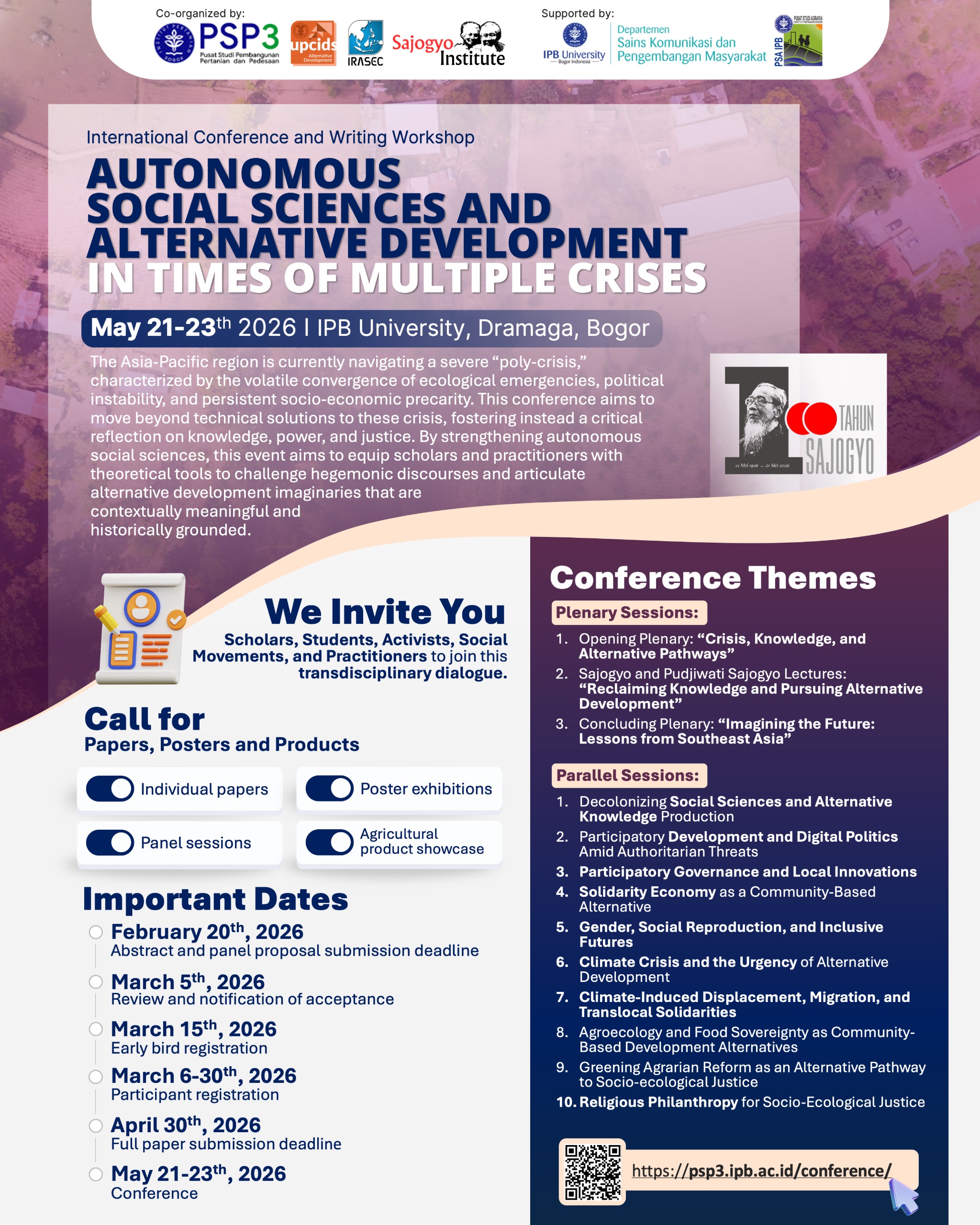
The Asia-Pacific region is currently navigating a severe “poly-crisis,” characterized by the volatile convergence of ecological emergencies, political instability, and persistent socio-economic precarity. As the home to sixty percent of the global population, the region faces intensifying hydro-meteorological disasters—from rising sea levels to shifting precipitation regimes—which do not occur in a vacuum but intersect with deep structural inequalities. In Southeast Asia, this fragility is compounded by a resurgence of authoritarianism and the “shrinking of civic space,” which marginalizes the very civil society actors essential for disaster response. Mainstream development paradigms, often anchored in top-down technological fixes and macroeconomic growth, have frequently exacerbated these vulnerabilities, leading to environmental degradation and the dispossession of local communities through projects that disregard indigenous life-worlds.
In response to these failures, alternative development frameworks—locally rooted, ecologically regenerative, and socially just—are emerging as vital counterweights. Across the region, grassroots initiatives in agroecology, solidarity economies, and participatory resource governance are demonstrating that situated knowledges can deliver resilience where universalist models fail. However, for these praxis-based alternatives to effectively reshape policy and global theory, we must confront an underlying epistemic crisis. Mainstream social sciences in the Global South often suffer from the “captive mind” (S.H. Alatas, 1974), characterized by an uncritical reliance on Western concepts that render local realities invisible. To bridge the gap between grassroots innovation and formal institutions, there is an urgent need to cultivate knowledge production that is autonomous yet globally engaged.
Autonomous social science serves as the critical bridge in this endeavor. It does not advocate for isolationism or a rejection of global scholarship, but rather calls for a “dialogical engagement” rooted firmly in local histories and community priorities. This approach challenges the “coloniality of knowledge” by empowering scholars and communities to define their own categories of justice and resilience, rather than relying on derivative frameworks. Crucially, as argued by Syed Farid Alatas (2025), true intellectual autonomy also requires liberation from internal hegemonic biases—such as androcentrism, culturalism, and sectarianism—that often predate colonialism. By transcending both external Eurocentrism and internal prejudices, social sciences can regenerate from the Global South to address the power dynamics inherent in ecological and political transformations.
It is within this landscape of urgency and opportunity that PSP3 IPB University, in collaboration with AltDev UP CIDS (Philippines), IRASEC (Thailand), and the Sajogyo Institute (Indonesia), convenes this International Conference and Writing Workshop. This event is designed to move beyond technical solutions to climate change, fostering instead a critical reflection on knowledge, power, and justice. By strengthening autonomous social sciences, we aim to equip scholars and practitioners with the theoretical tools to challenge hegemonic discourses and articulate alternative development imaginaries that are contextually meaningful and historically grounded.
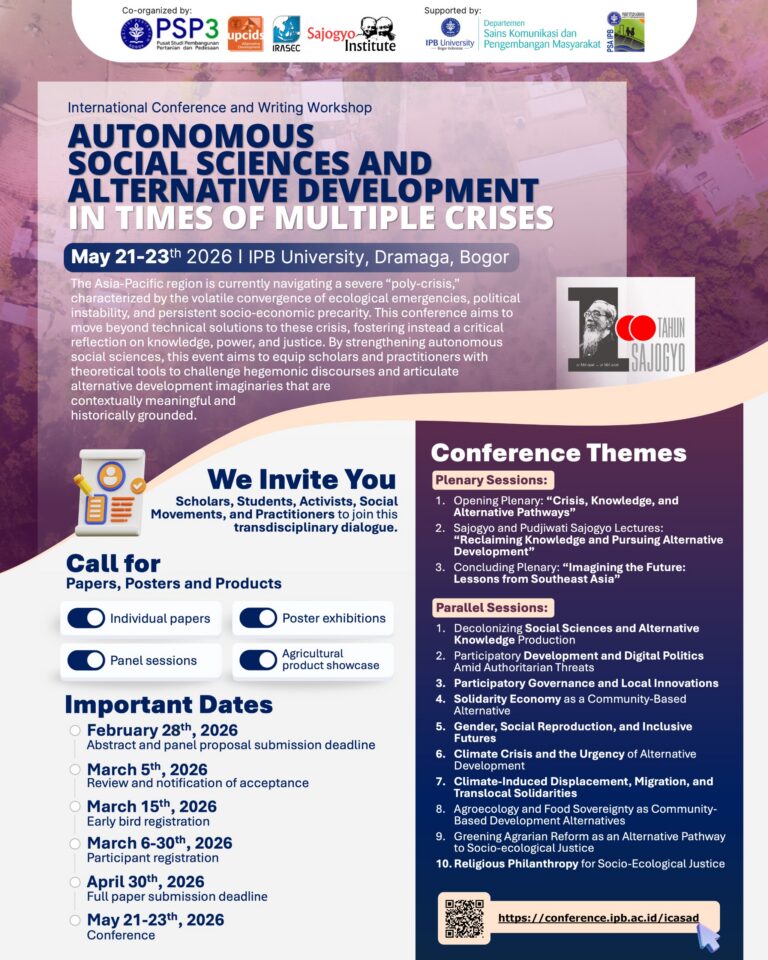
We invite scholars, activists, and practitioners to join this transdisciplinary dialogue. This conference seeks to catalyze collaboration across national boundaries, elevate marginalized knowledges, and generate tangible scholarly outputs that influence both academic infrastructures and policy sectors. Aligned with IPB University’s strategic goal of fostering global research networks, this initiative serves as a platform to assert agency over our collective futures, ensuring that the response to the poly-crisis is defined by pluralism, intellectual sovereignty, and social justice.
The general theme of the conference is “Autonomous Social Sciences and Alternative Development in Times of Multiple Crises”. This theme is elaborated through several topics as follows:
Plenary Sessions:
Opening reflections on the intertwined of ecological, socio-economic, political, and epistemic crises confronting Southeast Asia, and explorations on the contribution of autonomous social sciences and trans-disciplinary approaches for alternative development pathways.
Discussing efforts to decolonize knowledge, pursue epistemic sovereignty, and articulate alternative development frameworks rooted in Indonesian histories and contexts, inspired by intellectual legacies of late Prof. Sajogyo and Prof. Pudjiwati Sajogyo.
Forward-looking synthesis highlighting contributions from the conference to global debates, identifying lessons learned, and projecting future research agendas for just and sustainable development.
Parallel Sessions:
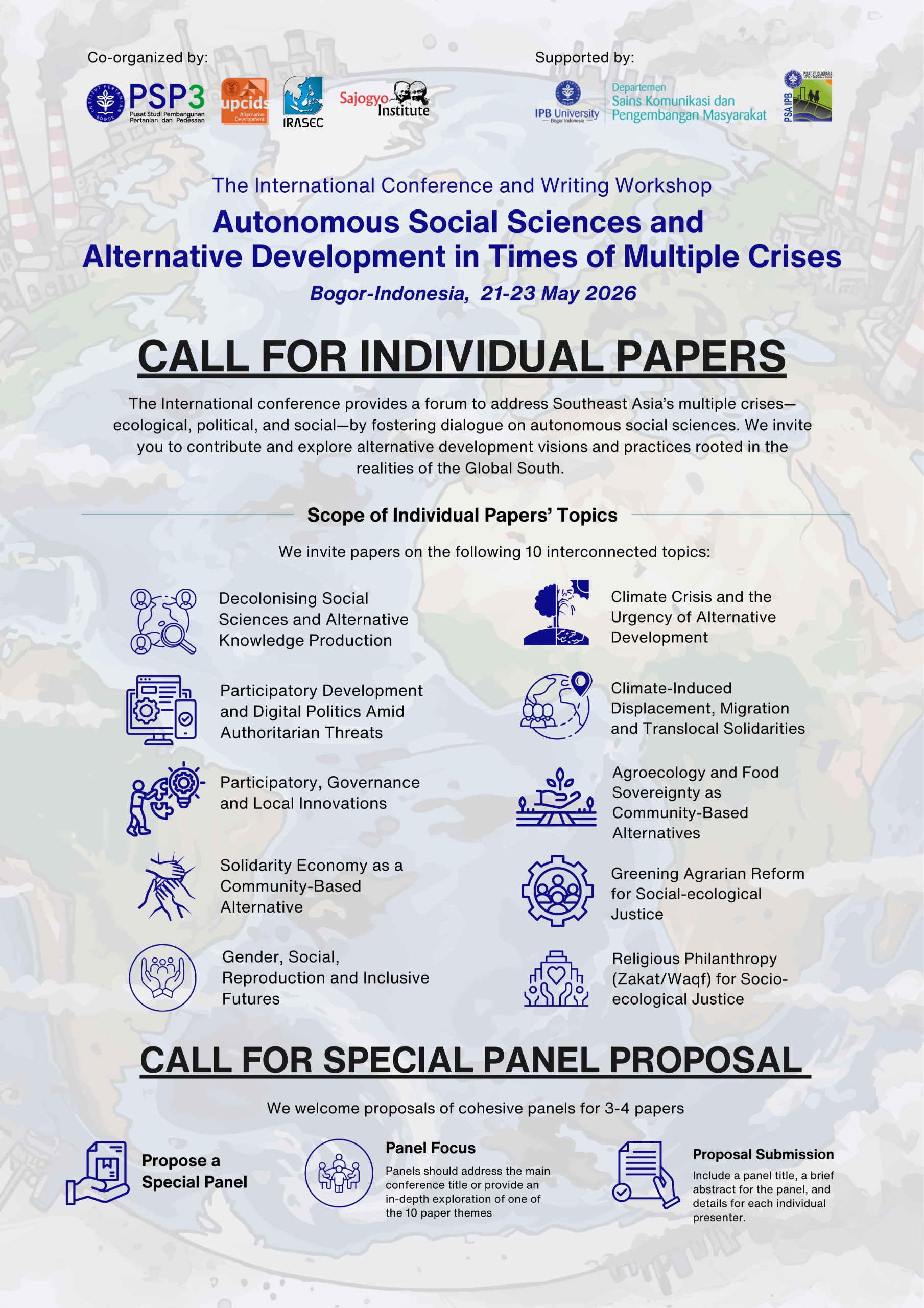
The parallel sessions will allow for in-depth discussion across ten interrelated thematic tracks:
Critiquing epistemic dependency and proposing ways to build autonomous social sciences in Southeast Asia.
Exploring challenges of shrinking civic spaces in Southeast Asia and the significance of digital politics and youth activism in shaping inclusive futures.
Highlighting community innovations in natural resource management, local policy-making, and citizen deliberation.
Examining practices of cooperatives, credit unions, mutual-aid networks, and solidarity-based enterprises that enhance resilience and self-reliance.
Analysing gendered dimensions of crisis and highlighting feminist approaches to care economies, social reproduction, and sustainable futures.
Challenging neoliberal development in light of the climate emergency; showcasing grassroots initiatives and policy alternatives that confront climate risks while offering just alternatives.
Addressing how climate-induced displacement, labour migration, and transnational networks reshape community resilience and development strategies.
Discussing agroecology, agroforestry, and food sovereignty as strategies for sustainability and decolonization of food systems.
Exploring land reform in the climate era: integrating redistribution, ecological restoration, and sustainable land management as pathways to socio-ecological justice.
Investigating the roles of zakat, waqf, and other religious philanthropic schemes in redistributive justice and grassroots empowerment.
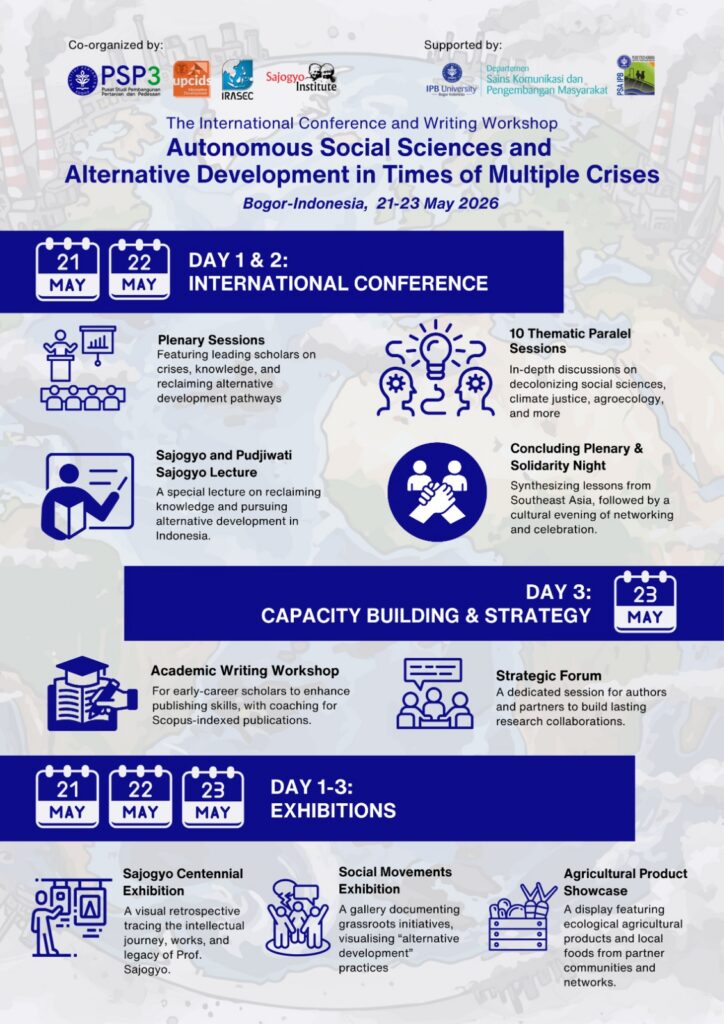
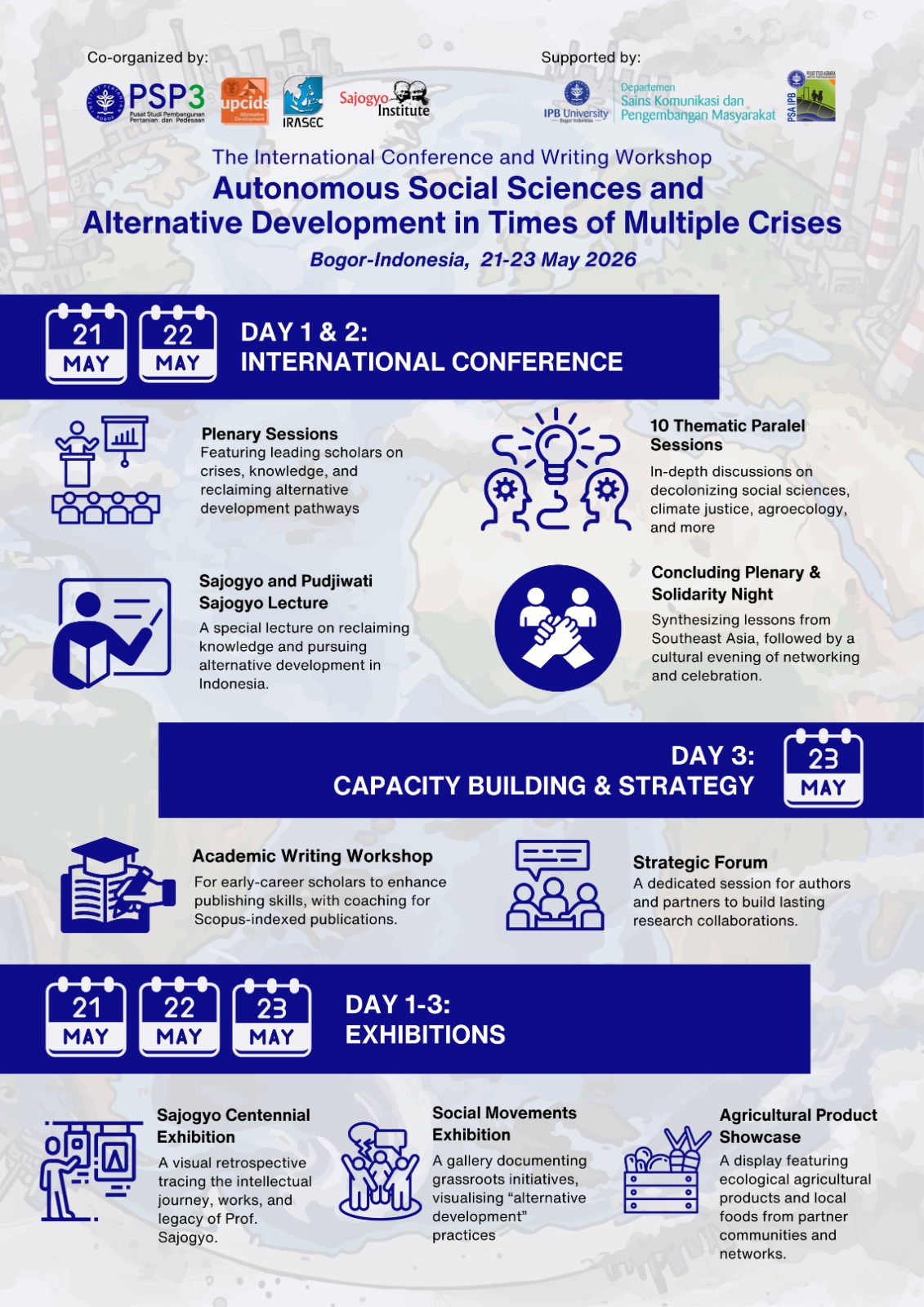
The event formats are developed as follows:
Conference
A primary forum featuring prominent international and national speakers to reflect on multi-dimensional crises—ecological, political, and epistemic. These sessions explore the decolonisation of knowledge and formulate future visions for alternative development rooted in Southeast Asian realities.
In-depth discussion spaces divided into ten interconnected thematic tracks. Scholars and practitioners present research findings to foster comparative dialogue, cross-country learning, and the elevation of grassroots voices.
An evening of camaraderie celebrating the spirit of community resilience. Hosted by the Sajogyo Institute, this session dissolves the boundaries between “researcher” and “activist” through the appreciation of art, music, poetry, and shared reflection in a warm, humanistic atmosphere.
A capacity-building activity for early-career researchers and postgraduate students. The agenda includes an academic writing “coaching clinic” and hands-on mentoring sessions with journal editors and peer reviewers to assist participants in meeting international publication standards (Scopus).
An exclusive post-workshop forum for authors, editors, and partner institutions to concretise next steps. The primary focus is designing future research collaboration agendas and institutionalising the “Autonomous Social Sciences” network for long-term sustainability.
Exhibitions
A visual retrospective tracing the intellectual journey, works, and legacy of Prof. Sajogyo as a pioneer of rural sociology in Indonesia, highlighting his contributions to agrarian justice and the empowerment of marginalised communities.
A gallery documenting grassroots initiatives and collective actions from various civil society organisations. This exhibition visualises “alternative development” practices and community resistance in the face of ecological crises and shrinking civic spaces.
A display featuring ecological agricultural products and local foods from partner communities and networks. This showcase tangibly promotes the concepts of food sovereignty, agroecology, and the solidarity economy.
This international conference is organised by the Centre for Agricultural and Rural Development Studies (PSP3), IPB University, in strategic partnership with the following international and national partners:
Furthermore, this event is supported by two additional units within IPB University: the Centre for Agrarian Studies and the Department of Communication and Community Development Sciences, Faculty of Human Ecology.




The conference outputs include:
Sajogyo Centennial: Honoring a Pioneer
This conference holds profound historical significance as the culmination of the Sajogyo Centennial (May 21, 1926 – May 21, 2026). The opening date was deliberately chosen to coincide with the 100th birth anniversary of the figure revered as “the Father of Indonesian Rural Sociology”.
Prof. Sajogyo was not merely an academic; he was the foundational thinker behind critical perspectives on agrarian structures, poverty, and solidarity with rural communities in the country. He was also the founder and first director of the Center for Agricultural and Rural Development Studies (PSP3) at IPB University (established in 1973), the institution that proudly hosts this event.
This centennial momentum serves as a reflective starting point to revitalize the spirit of “Autonomous Social Sciences” that he pioneered—a science that does not distance itself from the reality of the people, but grows from it to answer their problems.
Conference Formats and Components
The conference will be implemented in a hybrid format:
The program is structured into three main components:
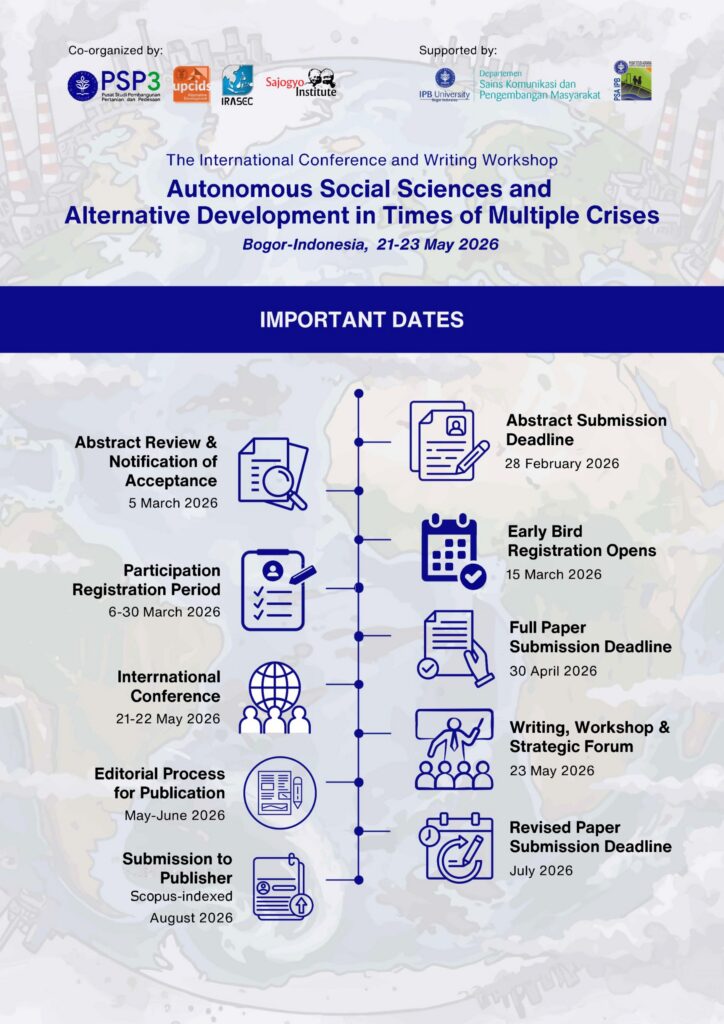
The Call for Papers (individual or full session) is now open.
Individual
Individual paper submissions by an author(s) that, if accepted, could be incorporated into any session type, at the convener’s choosing.
Individual paper submission by an author(s) that will be incorporated into the poster hall. Posters will be available to view during the conference, providing greater opportunity for poster presenters to solicit feedback and engage in critical discussion of their research. Attendees will be able to provide comments directly to the presenters and would also be able to arrange for time to meet onsite at the meeting.
Full Session
A full panel proposal is a fully formed panel session. You must submit all panel details, including panelist names, paper titles, and abstracts. Full paper panels can have up to five papers on a panel. All panelists must be in agreement that they will participate if the panel is selected.
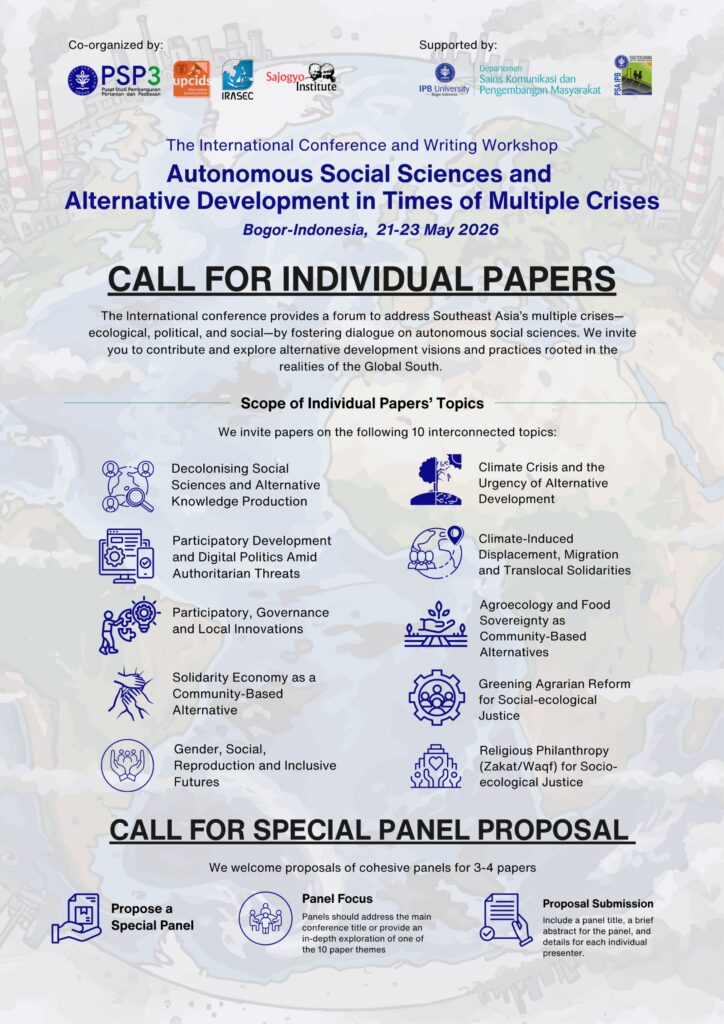
To ensure a rigorous, transparent, and efficient peer-review process, all abstract, paper and poster submissions will be managed through our dedicated Open Journal Systems (OJS) platform at https://conference.ipb.ac.id/icasad/about.
Abstracts, papers and posters should be written in English and have to be submitted through the following link: https://conference.ipb.ac.id/icasad/about/submissions.
For more information, please reach the following contacts:
Principal Contact
Dr. Ranti Wiliasih, S.P., M.Si
psp3@ipb.ac.id
Support Contact
Mohamad Shohibuddin
m-shohib@ipb.ac.id
Hubungi kami